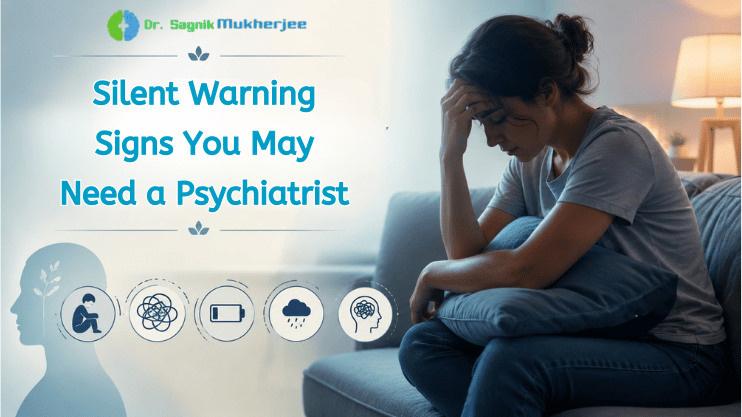
12 Silent Signs You Should See a Psychiatrist Before Your Mental Health Gets Worse
Mental health problems do not always announce themselves with a crisis. Often, the first changes are quiet. You stop replying to messages. Sleep becomes unpredictable. Work takes twice as much effort. Your patience gets shorter. You feel tired even after resting, and things that once mattered start feeling strangely unimportant.
Because these changes can develop gradually, people often normalize them. They tell themselves they are stressed, lazy, overworked, or simply going through a difficult phase. Sometimes that is true. But when several changes persist, worsen, or begin affecting everyday functioning, they deserve proper evaluation. The American Psychiatric Association specifically identifies changes in sleep, mood, social engagement, thinking, personal care, and functioning among warning signs that may warrant assessment.
Seeing a psychiatrist early does not automatically mean medication or a serious psychiatric diagnosis. It means finding out what is happening before symptoms become harder to manage.
Why Early Mental Health Changes Are Easy to Miss
Many psychiatric conditions develop gradually rather than appearing overnight. Family members, coworkers, or the person themselves may first notice a vague sense that something is different. Early intervention can reduce the impact of developing mental health problems and may help prevent symptoms from progressing into a more serious illness.
One symptom by itself does not necessarily indicate mental illness. What matters is the pattern. Several symptoms occurring together, continuing for weeks, or interfering with work, relationships, self-care, or daily responsibilities are stronger reasons to seek professional assessment.
Here are 12 quieter warning signs that are easy to dismiss.
- Chronic fatigue that does not improve with rest can be an early clue. You may sleep for eight hours and still wake up exhausted, struggle to get through ordinary tasks, or need far more recovery time than before. Fatigue can occur with depression, anxiety, chronic stress, sleep disorders, medication effects, thyroid conditions, anemia, and other medical problems. A psychiatric evaluation can help determine whether emotional distress is part of the picture while making sure physical causes are not ignored.
- Social withdrawal often develops slowly. You may start declining invitations, avoiding phone calls, eating alone, or feeling irritated when someone wants to talk. Sometimes you tell yourself you simply need space. But when isolation becomes your default and activities or relationships you once valued no longer feel worth the effort, it can signal depression, anxiety, burnout, psychosis, or another mental health concern. Social withdrawal and loss of interest are recognized warning signs that deserve attention when they represent a meaningful change from your usual behavior.
- Major sleep changes are another common warning sign. You may struggle to fall asleep, wake repeatedly, sleep far longer than usual, or find your sleep schedule completely reversed. Sleep problems can occur before, during, or alongside depression, anxiety, bipolar disorder, substance-related problems, and other psychiatric conditions. Persistent sleep disruption also makes emotional regulation harder, creating a cycle where poor sleep worsens mental health and worsening mental health further damages sleep.
- Irritability that feels increasingly difficult to control is easy to misread as a personality problem. You may snap at family members, become disproportionately angry about minor inconveniences, or feel constantly overstimulated. Irritability can be associated with chronic stress, anxiety, depression, sleep deprivation, trauma-related conditions, substance use, and mood disorders. A noticeable increase in irritability or dramatic emotional shifts can be a reason for further assessment.
- Brain fog and difficulty concentrating can quietly damage everyday functioning. You may reread the same paragraph several times, forget what someone just told you, lose your train of thought during meetings, or struggle to make routine decisions. Problems with concentration, memory, logical thinking, or speech that are difficult to explain are among the cognitive changes clinicians take seriously. A psychiatrist can help distinguish whether these difficulties are related to depression, anxiety, sleep problems, medication effects, substance use, attention disorders, or another condition. Progressive or sudden cognitive decline may also require medical or neurological evaluation.
- Losing interest in things you once enjoyed can be more significant than simply “getting bored.” You may stop exercising, cooking, meeting friends, playing music, watching shows you liked, or participating in family activities. When pleasure, motivation, and curiosity disappear for weeks, especially alongside fatigue, sadness, sleep changes, or hopelessness, depression should be considered. Apathy and loss of initiative are also recognized early warning signs of worsening mental health.
- Everyday responsibilities becoming unusually difficult is another important clue. You may start missing deadlines, skipping classes, forgetting bills, avoiding basic household chores, or struggling with tasks you previously completed without much effort. An unexplained drop in functioning at work, school, or socially is a stronger warning sign than having a few bad days. Mental health conditions often become clinically significant when symptoms begin interfering with a person’s ability to function.
- Relying increasingly on alcohol, nicotine, sleeping tablets, cannabis, or other substances to regulate emotions deserves attention. What begins as “something to relax after work” can gradually become the main way you sleep, socialize, escape anxiety, or numb difficult emotions. Substance use can also worsen depression, anxiety, impulsivity, sleep, and medication response. If you find yourself needing a substance to feel normal or to get through difficult emotions, discussing it honestly with a psychiatrist is more useful than waiting for consequences to become severe.
- Feeling emotionally numb can be just as important as feeling intensely sad. Some people with depression do not describe themselves as unhappy. They say they feel nothing. Positive events do not excite them, difficult events barely register, and relationships begin to feel distant. Emotional disconnection can also occur with trauma, chronic stress, burnout, medication effects, and dissociative symptoms. A persistent feeling of being disconnected from yourself or your surroundings is another change clinicians may evaluate carefully.
- Personal care gradually slipping can be a quieter warning sign of declining mental health. Showering, changing clothes, preparing meals, brushing your teeth, cleaning your room, or attending routine medical appointments can start feeling overwhelming. This often happens because energy, motivation, concentration, or executive functioning has deteriorated. A decline in personal care is recognized as a possible warning sign, particularly when it appears alongside other emotional or behavioral changes.
- Persistent suspiciousness, unusual beliefs, or feeling that things have hidden meanings should not simply be written off as overthinking. Some people begin feeling that others are watching them, talking about them, or deliberately trying to harm them. Others develop beliefs that seem increasingly disconnected from how people around them understand reality. New suspiciousness, unusual thinking, severe paranoia, or perceptual changes can occur with psychotic disorders, mood disorders, substance use, neurological illness, severe sleep deprivation, and some medical conditions. These symptoms deserve prompt assessment rather than confrontation or ridicule.
- Feeling hopeless or thinking that others would be better without you is the sign that should never be minimized. You do not need to have made a suicide plan for these thoughts to matter. Persistent thoughts about death, wishing you would not wake up, feeling like a burden, self-harm urges, or believing there is no future are reasons to seek help quickly. Suicidal thoughts, intent, or thoughts of harming others require immediate attention.
What Happens When You See a Psychiatrist Early
A psychiatrist does more than decide whether you need medication. A proper evaluation looks at when symptoms began, how they have changed, sleep, appetite, energy, concentration, mood, anxiety, substance use, medical conditions, medications, family history, life events, and the impact symptoms are having on everyday functioning.
Sometimes the problem is a psychiatric condition such as depression, an anxiety disorder, bipolar disorder, obsessive-compulsive disorder, trauma-related illness, or another mental health condition. Sometimes symptoms are being amplified by chronic sleep loss, substance use, medication effects, thyroid disease, vitamin deficiencies, neurological illness, or other medical factors.
The treatment plan depends on what the evaluation finds. It may involve psychotherapy, lifestyle changes, sleep treatment, medication, substance-use support, family involvement, or referral to another medical specialist.
Medication is not automatically required. Early psychiatric care is about matching treatment intensity to the actual problem.
Do Not Wait Until Your Life Falls Apart
People often think they need to be “bad enough” before seeing a psychiatrist. That is a poor threshold.
If your work performance is slipping, relationships are deteriorating, sleep has changed dramatically, you no longer enjoy anything, substances are becoming a coping strategy, or your thoughts and emotions feel increasingly difficult to manage, that is already enough reason to get assessed.
Early intervention is generally easier than crisis management. Mental health care works better when there is still room to make changes before symptoms have damaged several areas of life.
If you are unsure whether your symptoms require psychiatric care, an evaluation can answer that question. You do not need to diagnose yourself first.
When You Need Urgent Help Instead of a Routine Appointment
Do not wait for a scheduled psychiatric consultation if you have active suicidal intent, cannot keep yourself safe, are experiencing severe hallucinations or paranoia, have become extremely agitated or confused, have gone several nights without sleep alongside major behavioral changes, or are thinking seriously about harming another person.
These situations require urgent professional or emergency evaluation.
A Practical Takeaway
Mental health deterioration often starts quietly. Chronic fatigue, withdrawal, sleep changes, irritability, brain fog, loss of interest, declining functioning, increased substance use, emotional numbness, poor self-care, suspicious thinking, and hopelessness can all be signals that something needs attention.
You do not need all 12 signs. You do not even need a diagnosis. If several changes are persisting and your normal life is becoming harder to manage, seeing a psychiatrist early is a sensible medical decision.
Mental health symptoms can have psychiatric, neurological, medical, medication-related, and substance-related causes. If symptoms persist, worsen, or interfere with daily functioning, consult a qualified psychiatrist or healthcare professional. If you have suicidal thoughts, intent to harm yourself or someone else, or cannot remain safe, seek urgent medical attention immediately. Get in touch with Dr. Sagnik Mukherjee for psychiatric help in Kolkata.

Dr. Sagnik Mukherjee is a highly regarded psychiatrist in Kolkata, bringing over a decade of experience in mental health to his practice. With a medical degree from Chittaranjan Hospital and an MD in psychiatry, his expertise spans adult psychiatry, geriatric psychiatry, child psychiatry, depression, anxiety-related disorders, and relationship issues. He has built a strong professional foundation, having worked at esteemed institutions such as Chittaranjan Hospital, SVS Medical College & Hospital, KPC Medical College, and Iris Hospital. His clinic is known for its advanced technology and state-of-the-art infrastructure, providing personalised mental health care, including medication management, individual and group therapy, and specialised services for substance abuse and eating disorders. His holistic approach takes into account lifestyle, diet, environment, and family dynamics when creating effective treatment plans. Additionally, he’s a respected TV speaker on social issues and offers online consultations for patient convenience, making him a trusted figure in the field of psychiatry in Kolkata.