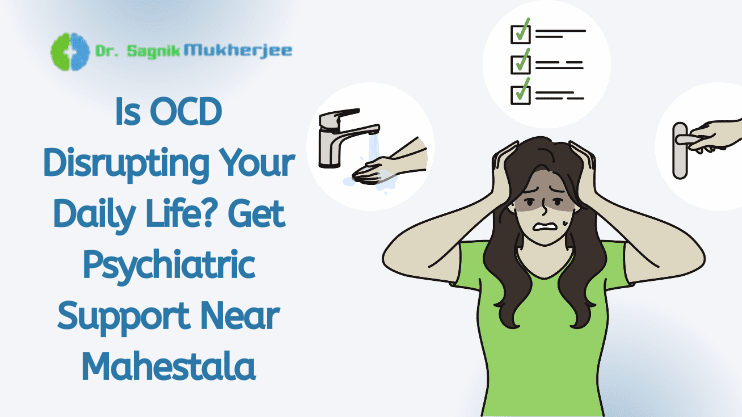
OCD Taking Over Your Routine? Find Psychiatric Help Near Mahestala
Do you find yourself checking the locks repeatedly before leaving home? Does your mind refuse to quieten unless you’ve arranged objects in a particular order? Perhaps you’ve noticed your loved one washing their hands until they’re raw, or counting steps obsessively before entering a room. If these patterns sound familiar, you’re not alone—and more importantly, you’re in the right place to understand what’s happening and how to reclaim control.
I’m Dr. Sagnik Mukherjee, and over the years of practising psychiatry, I’ve witnessed firsthand how Obsessive-Compulsive Disorder quietly infiltrates lives, transforming confident individuals into prisoners of their own thoughts. What compels me to speak openly about OCD is the sheer number of families I’ve seen who suffered in silence, believing their struggles were personal failings rather than a treatable medical condition. Having dedicated my career to understanding the intricate patterns of the human mind, I’ve made it my mission to break the stigma surrounding mental health conditions and ensure that people near Mahestala and beyond have access to evidence-based, compassionate care.
Understanding the Grip of Obsessive Compulsive Disorder
OCD isn’t simply about being organised or particular. It’s a chronic condition where unwanted, intrusive thoughts (obsessions) trigger intense anxiety, leading to repetitive behaviours or mental rituals (compulsions) performed to temporarily ease that distress. The cycle becomes exhausting:
- Obsessive thoughts emerge – fears of contamination, harming others, or things being “not right”
- Anxiety escalates – the mind fixates on these fears relentlessly
- Compulsive behaviours follow – washing, checking, counting, arranging
- Temporary relief occurs – but only briefly
- The cycle repeats – often stronger than before
What makes OCD particularly insidious is how it masquerades as personal responsibility. “I’m just being careful,” people tell themselves. “I’m preventing something terrible.” But when these thoughts and rituals consume hours daily, when they prevent you from reaching work on time, when relationships strain under the weight of inexplicable rules, that’s when OCD has crossed from quirk to crisis.
How OCD Dismantles Daily Life
Let me share what I observe regularly in my practice:
At Work:
- Missing deadlines because of perfectionism rituals
- Inability to delegate tasks for fear of contamination or mistakes
- Exhaustion from mental compulsions interrupting concentration
- Avoiding colleagues to hide repetitive behaviours
In Relationships:
- Partners feeling rejected by contamination fears
- Children confused by parent’s rigid rules
- Social isolation from embarrassment about rituals
- Intimacy suffering due to intrusive thoughts
Personal Confidence:
- Shame about “irrational” thoughts you can’t control
- Self-blame for time wasted on compulsions
- Loss of identity beyond the OCD patterns
- Hopelessness about ever feeling “normal” again
The tragedy isn’t that OCD exists, it’s that so many people endure it unnecessarily, unaware that specialised treatment can genuinely restore their lives.
Why Specialised Psychiatric Care Makes the Difference
As a best psychiatrist practising near Mahestala, I’ve seen recovery happen countless times when the right approach meets individual commitment. Here’s what proper psychiatric intervention involves:
1. Accurate Diagnosis
Not every repetitive behaviour signals OCD. An expert psychiatrist distinguishes between OCD, generalised anxiety, autism spectrum traits, or other conditions requiring different treatments. Precision matters enormously in mental health care.
2. Cognitive Behavioural Therapy (CBT)
Specifically, Exposure and Response Prevention (ERP)—the gold standard for OCD treatment. This involves:
- Gradually confronting feared situations
- Resisting the urge to perform compulsions
- Learning that anxiety naturally decreases without rituals
- Building tolerance to uncertainty
3. Medication When Appropriate
Selective Serotonin Reuptake Inhibitors (SSRIs) help regulate brain chemistry underlying OCD. A professional psychiatrist carefully monitors dosage and response, adjusting treatment as needed. Medication isn’t about numbing your personality—it’s about quieting the noise so you can engage with therapy effectively.
4. Family Psychoeducation
Recovery accelerates when loved ones understand OCD’s mechanisms and learn how to support without enabling compulsions. I always involve families in treatment planning because their role is invaluable.
5. Relapse Prevention Strategies
OCD management is a skill set. We work together to identify triggers, develop coping mechanisms, and create sustainable routines that protect your progress long-term.
What Recovery Actually Looks Like
I want to be transparent: OCD treatment isn’t about achieving a thought-free mind. It’s about changing your relationship with intrusive thoughts. Success means:
- Experiencing obsessive thoughts but not being controlled by them
- Choosing whether to engage in compulsions rather than feeling compelled
- Tolerating discomfort without immediate ritual performance
- Reclaiming time for activities that matter to you
- Rebuilding relationships damaged by OCD patterns
Recovery is absolutely possible. I’ve witnessed individuals who couldn’t leave their homes without two-hour checking rituals now travelling freely. I’ve seen parents who feared harming their children—despite having no desire to—now enjoying relaxed, loving interactions. The transformation happens through consistent work with an expert psychiatrist who understands OCD’s complexities and remains committed to your progress.
Why Local Access to Care Matters
Seeking psychiatric help near you offers practical advantages. We have many patients from Mahestala who come to us regularly. Regular therapy sessions become manageable without lengthy travel. Crisis support is accessible. Your psychiatrist understands the community context of your life. Most importantly, proximity removes barriers to consistency, the cornerstone of successful OCD treatment.
Your Next Step Towards Freedom
If OCD has been dictating your schedule, straining your relationships, or stealing your peace, please know that this doesn’t have to be your permanent reality. You deserve support from a professional psychiatrist who sees your potential beyond the symptoms, who brings both expertise and genuine compassion to your care.
I invite you to take that courageous first step. Reach out to discuss how we can work together towards your recovery. Call me at 98313 13020 and let’s begin the conversation about reclaiming your life from OCD. At the Best Psychiatric Clinic Kolkata, we’re committed to providing evidence-based treatment in an environment of complete confidentiality and respect. You’ve already shown tremendous strength by recognising the problem. Now let’s channel that strength into healing. Your routine can belong to you and not to OCD.

Dr. Sagnik Mukherjee is a highly regarded psychiatrist in Kolkata, bringing over a decade of experience in mental health to his practice. With a medical degree from Chittaranjan Hospital and an MD in psychiatry, his expertise spans adult psychiatry, geriatric psychiatry, child psychiatry, depression, anxiety-related disorders, and relationship issues. He has built a strong professional foundation, having worked at esteemed institutions such as Chittaranjan Hospital, SVS Medical College & Hospital, KPC Medical College, and Iris Hospital. His clinic is known for its advanced technology and state-of-the-art infrastructure, providing personalised mental health care, including medication management, individual and group therapy, and specialised services for substance abuse and eating disorders. His holistic approach takes into account lifestyle, diet, environment, and family dynamics when creating effective treatment plans. Additionally, he’s a respected TV speaker on social issues and offers online consultations for patient convenience, making him a trusted figure in the field of psychiatry in Kolkata.